
Slash MTTR: Automated Incident Response for DevOps
The High Cost of System Downtime
Every minute of system downtime costs modern enterprises significant revenue, damages brand reputation, and frustrates end-users. As digital ecosystems grow increasingly complex, reducing Mean Time to Recovery (MTTR) has shifted from a best practice to a critical survival metric. Modern DevOps and Site Reliability Engineering (SRE) teams are battling an unprecedented volume of system alerts, leading to severe alert fatigue. When engineers are bombarded with thousands of notifications daily, distinguishing critical failures from transient noise becomes nearly impossible.
Manual troubleshooting simply cannot scale to meet the demands of modern cloud-native architectures. Traditional incident response methods, which rely heavily on human intervention and manual log parsing, are breaking under immense pressure. Engineers are struggling to keep up with the sheer volume of data generated by distributed microservices.
Automated Incident Response has emerged as the ultimate solution to this operational crisis. New AI-driven tools are fundamentally transforming how complex systems recover from catastrophic failures, allowing teams to drastically slash MTTR. These advanced platforms eliminate the repetitive manual toil that leads to engineer burnout. By automating the triage and remediation phases, developers are freed from the constant burden of fighting fires and can redirect their focus toward building innovative features. Adopting Agentic AI in the incident response pipeline provides a massive competitive advantage in today’s fast-paced tech landscape. We will explore the mechanics of this technology and how it is reshaping the future of software reliability.

The Evolution of Incident Response
Historically, Site Reliability Engineering relied heavily on reactive, manual processes. An infrastructure anomaly would trigger a pager, often waking an on-call engineer in the middle of the night. That engineer would log into a server, manually grep through endless streams of log files, and attempt to piece together the root cause of the outage. Because this process was inherently slow and prone to human error, MTTR remained stubbornly high. As system complexity grew exponentially over the past decade—driven by the adoption of Kubernetes, serverless functions, and multi-cloud environments—these manual SRE practices quickly became obsolete.
Basic observability tools eventually emerged to help engineers make sense of their environments, but they brought their own set of challenges. Tool fragmentation caused entirely new operational blind spots, as teams were forced to context-switch between separate dashboards for metrics, logs, and distributed traces. The industry is currently experiencing a massive consolidation phase to address this sprawl. For instance, Atlassian announced the sunsetting of Opsgenie, with End of Support officially scheduled for 2027. This impending deadline is forcing engineering leaders to urgently re-evaluate their entire incident response stacks. Organizations that fail to adapt their strategies quickly risk severe operational vulnerabilities and prolonged downtime.
The Shift to Observability 2.0
The emergence of Observability 2.0 has fundamentally changed the operational landscape by unifying metrics, logs, and traces into a single, high-cardinality data store. This modern approach eliminates the isolated silos that characterized legacy monitoring tools. Engineers now gain immediate, rich context during an outage, allowing them to understand not just that a system failed, but exactly why it failed. Detection times plummet dramatically when teams have access to this unified, interconnected web of system data.
A critical enabler of this deep system visibility is eBPF-based telemetry. Extended Berkeley Packet Filter (eBPF) technology allows programs to run safely inside the operating system kernel without requiring changes to kernel source code or loading specialized modules. Engineers can observe kernel-level events, network traffic, and application behavior instantly. This lightweight instrumentation captures highly granular data with virtually zero performance overhead. This rich, real-time data stream serves as the perfect foundation for automated systems, feeding AI engines the precise context they need to make intelligent decisions.
// Example: A conceptual eBPF probe capturing network latency
SEC("kprobe/tcp_sendmsg")
int bpf_prog1(struct pt_regs *ctx) {
    u64 start_time = bpf_ktime_get_ns();
    // Track latency at the kernel level for AI analysis
    bpf_map_update_elem(&latency_map, &pid, &start_time, BPF_ANY);
    return 0;
}
Agentic AI and Autonomous Remediation
Generative AI is rapidly reshaping the boundaries of software development. Throughout 2026, Generative AI coding assistants have increased developer velocity by an estimated 40 percent across the industry. While this massive growth in productivity is a boon for feature delivery, it creates a dangerous phenomenon known as the Copilot Paradox. When developers write and deploy code faster than ever before, they inevitably introduce bugs and vulnerabilities at an equally accelerated rate. DevSecOps teams are finding themselves overwhelmed, desperately needing faster resolution tools to keep pace with the sheer volume of AI-generated code deployments.
Agentic AI steps in to solve this exact bottleneck. Unlike basic conversational chatbots that merely suggest potential fixes based on historical documentation, Agentic AI is designed to take independent, authorized action within your infrastructure. When an alert fires, the AI agent autonomously analyzes the incoming telemetry, navigates through the system architecture to gather necessary context, and formulates a precise remediation plan. Autonomous Remediation has transitioned from a futuristic concept into a practical reality, with the AI effectively acting as a highly skilled virtual SRE capable of executing complex recovery procedures at machine speed.
Transforming Root Cause Analysis
The most time-consuming aspect of any outage is Root Cause Analysis (RCA). Previously, RCA required hours of tedious manual investigation, cross-referencing dashboards, and debating theories in high-stress war rooms. Today, Agentic AI correlates millions of data points across the Observability 2.0 landscape in milliseconds. It can pinpoint the exact failing microservice, identify the specific code commit that introduced the regression, and highlight the anomalous behavior before a human engineer even opens their laptop. Human engineers are empowered to skip the grueling investigation phase entirely and focus solely on reviewing and approving the AI’s proposed solutions.
“The true power of Agentic AI lies not in replacing engineers, but in augmenting their capabilities. By automating root cause analysis, we transform incident response from a frantic search for a needle in a haystack into a streamlined, intelligent workflow.”
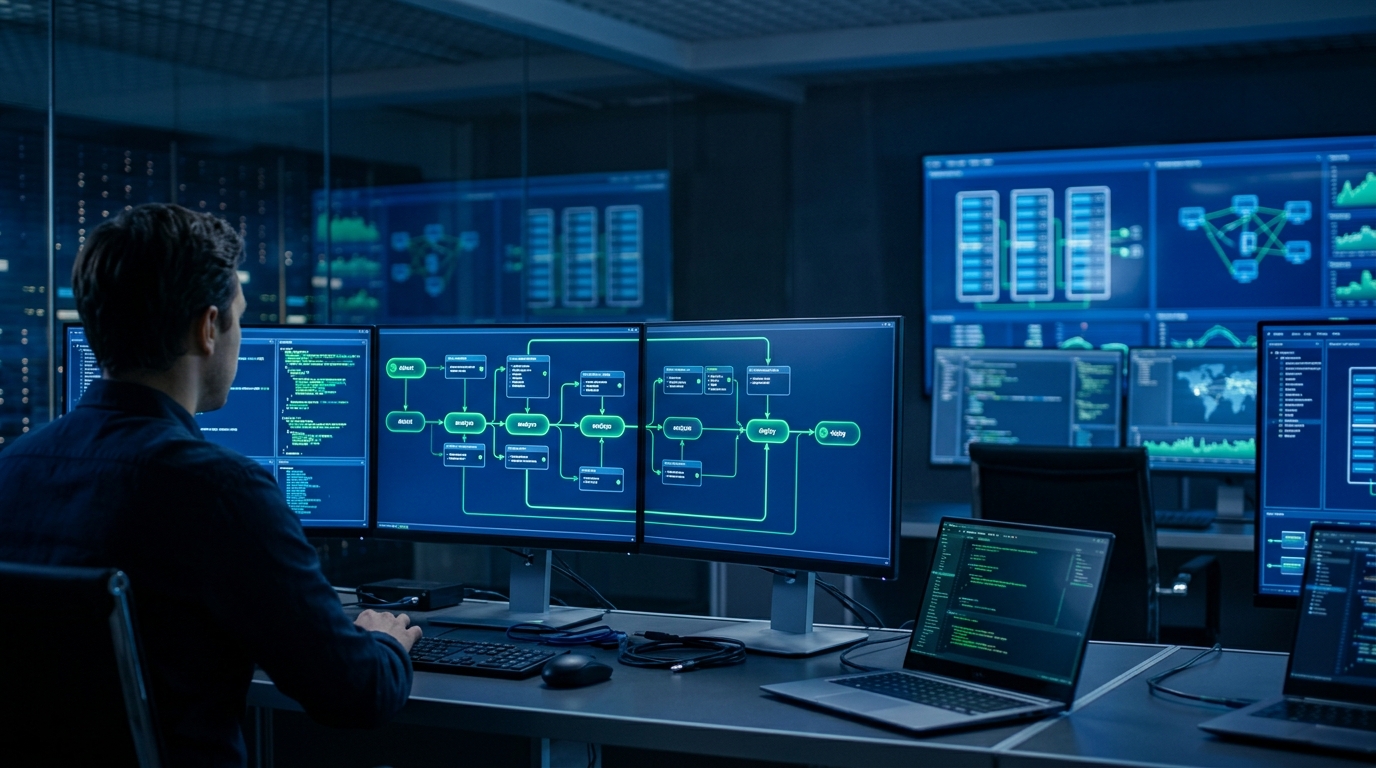
Beyond simple analysis, the AI executes Auto-healing workflows safely and predictably. When a system anomaly is verified, the agent can isolate the compromised container to prevent cascading failures. It can automatically roll back the faulty deployment to the last known stable state, restart the degraded service to restore immediate functionality, and dynamically adjust resource provisioning to handle unexpected traffic spikes. Once the system is stabilized, the AI generates a comprehensive, timeline-based post-mortem report for the engineering team. The ultimate goal is a self-healing infrastructure that resolves issues before end-users even notice a degradation in service.
The ROI of Automated Incident Response
Examining the hard numbers behind this technological shift reveals a compelling business case. Enterprises that fully integrate AI-driven automation into their DevOps pipelines are experiencing massive operational gains. Industry benchmarks from 2026 indicate that these forward-thinking organizations are reducing incident resolution times by 30 to 50 percent. This dramatic reduction in MTTR translates directly into millions of dollars saved in preserved revenue, avoided SLA penalties, and retained customer trust. The return on investment for modernized incident response platforms is undeniably strong and rapidly realized.
Manual coordination during an outage is incredibly wasteful. Research confirms that teams lose an average of 15 minutes per incident simply dealing with coordination overhead—waking people up, establishing a communication bridge, assigning roles, and bringing everyone up to speed on the current state of the system. This costly delay occurs before any actual troubleshooting even begins. Automating the initial triage phase reclaims those critical minutes during severe outages, directly protecting customer satisfaction and minimizing business disruption.
Technology leaders are taking decisive action based on these metrics. Currently, 67 percent of IT executives plan to switch their underlying observability platforms to support AI-native workflows, with most reporting this transition will happen within the next 12 to 24 months. Automation is no longer viewed as an optional luxury or an experimental initiative; it is a mandatory requirement for maintaining operational resilience in a highly competitive digital economy.
Traditional vs. Automated Incident Response
To truly understand the magnitude of this shift, we must compare these two distinct operational approaches side-by-side. The traditional model relies on human endurance and reactive alerting, while the automated model leverages machine speed and proactive intelligence. The table below highlights the stark differences between manual workflows and modern, AI-driven automated incident response.
| Feature | Traditional Incident Response | Automated Incident Response |
|---|---|---|
| Detection Speed | Minutes to hours (Manual alerts) | Milliseconds (eBPF-based telemetry) |
| Root Cause Analysis | Manual log searching and correlation | Instant AI-driven correlation |
| Remediation Action | Human engineers execute runbooks | Agentic AI executes Auto-healing workflows |
| Coordination Overhead | High (15+ minutes lost per incident) | Zero (Automated virtual war rooms) |
| Post-Mortem | Manually written after recovery | Automatically generated instantly |
As the comparison illustrates, modernization eliminates the most painful bottlenecks in the incident lifecycle. By shifting from manual runbooks to automated workflows, organizations can achieve a level of reliability that was previously impossible under the constraints of human reaction times.
The Auto-Healing Workflow Architecture
Understanding the underlying technical architecture is absolutely crucial for successful implementation. A robust auto-healing system requires a seamless integration of telemetry collection, intelligent analysis, and automated execution. The workflow begins at the infrastructure layer, where eBPF sensors continuously monitor system health. If a sudden latency spike occurs in a critical payment microservice, the sensors capture the anomaly in real-time. This high-fidelity telemetry data flows instantly into the Observability 2.0 platform, which aggregates the metrics and triggers the Agentic AI engine.
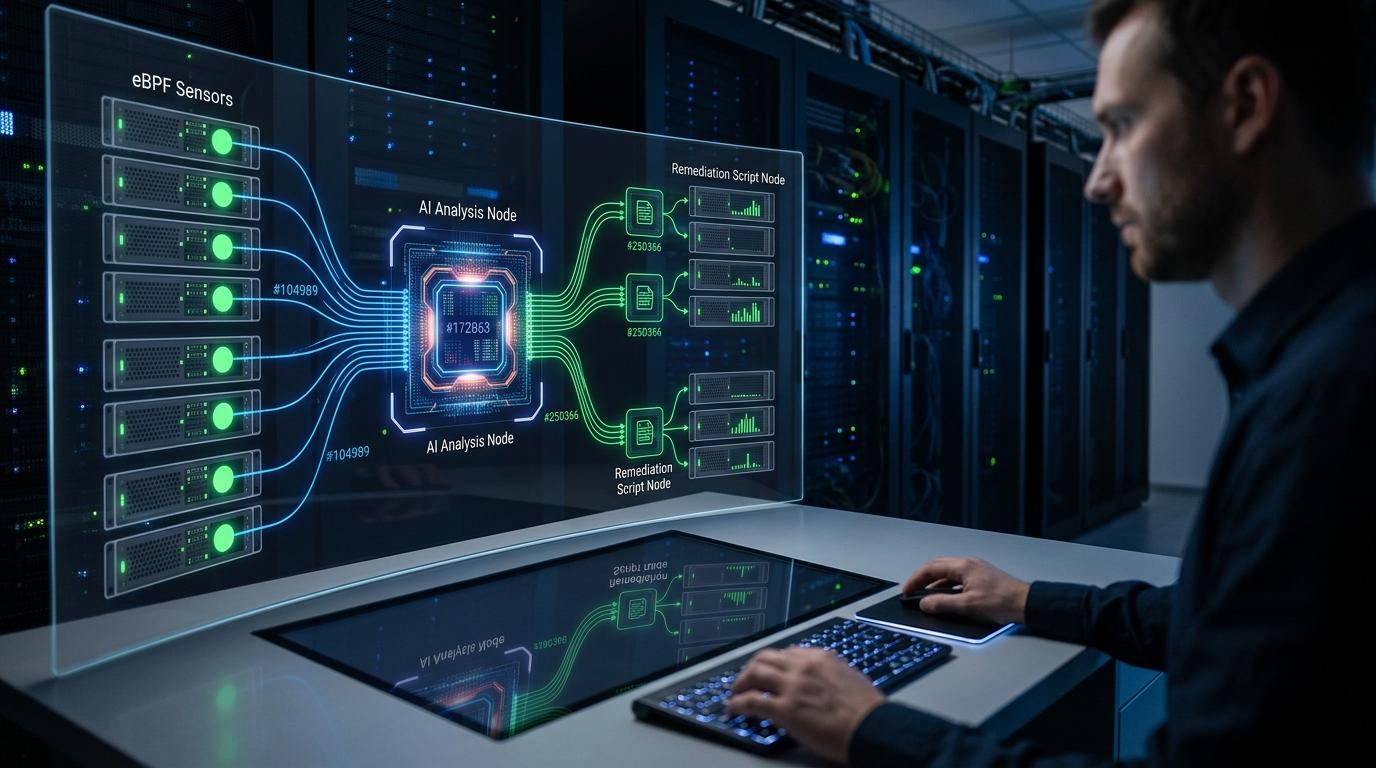
Upon receiving the alert, the AI engine performs rapid Root Cause Analysis by cross-referencing the latency spike with recent deployment logs and infrastructure changes. It might identify a memory leak introduced in the latest canary deployment. Recognizing the signature of the failure, the AI triggers a predefined auto-healing workflow via webhooks to the orchestration layer. The system automatically provisions a healthy instance running the previous stable version, gracefully drains traffic from the failing node to prevent dropped requests, and terminates the degraded instance safely. The entire sequence executes in a matter of seconds, shrinking MTTR drastically and preserving the user experience.
Conclusion and Next Steps
Automated Incident Response has evolved into a mandatory capability for modern DevOps and SRE success. It completely eliminates the tedious manual toil that leads to engineer burnout, while Agentic AI drives incredibly fast system recovery. As development velocity continues to accelerate—exacerbating the Copilot Paradox—engineering teams must evolve their operational practices to maintain stability and ensure continuous service delivery.
The journey toward a self-healing infrastructure requires a strategic approach. To begin building robust Auto-healing workflows today, follow these critical steps:
- Audit your stack: Evaluate your current observability tools to identify visibility gaps and manual bottlenecks in your incident lifecycle.
- Plan your migration: Transition away from legacy, fragmented tools like Opsgenie well before the 2027 end-of-support deadline.
- Deploy eBPF sensors: Implement eBPF-based telemetry to gain deeper, low-overhead system visibility at the kernel level.
- Embrace Observability 2.0: Unify your metrics, logs, and traces to provide your AI agents with the comprehensive context they need to make accurate decisions.
By taking these strategic steps today, you can empower your engineering teams with the tools they need to automate incident response, ultimately slashing MTTR and keeping your digital business running smoothly.
What is the Copilot Paradox in DevOps?
The Copilot Paradox refers to the phenomenon where AI coding assistants help developers write and deploy code much faster, which inadvertently introduces bugs and system vulnerabilities at an equally accelerated rate. This rapid deployment cycle overwhelms traditional incident response teams, necessitating AI-driven automation to keep pace with the increased volume of incidents.
How does eBPF improve incident response?
eBPF (Extended Berkeley Packet Filter) allows engineers to run sandboxed programs directly within the operating system kernel. This provides deep, real-time visibility into system calls, network traffic, and application performance with virtually no overhead. This rich data stream gives AI tools the precise, high-fidelity context needed for rapid root cause analysis and automated remediation.
Will Agentic AI replace Site Reliability Engineers (SREs)?
No. Agentic AI is designed to augment SREs, not replace them. By automating tedious tasks like log parsing, initial triage, and basic remediation, AI frees up human engineers to focus on complex architectural improvements, proactive reliability planning, and higher-level strategic work that requires human ingenuity.
What should teams do about the Opsgenie sunsetting?
With Atlassian announcing the end of support for Opsgenie in 2027, engineering teams should urgently audit their incident response workflows. Organizations must begin migrating to modern, unified Observability 2.0 platforms that offer native AI integration and automated remediation capabilities to avoid operational blind spots.